2026-01-15
On Memory & CPU Architecture
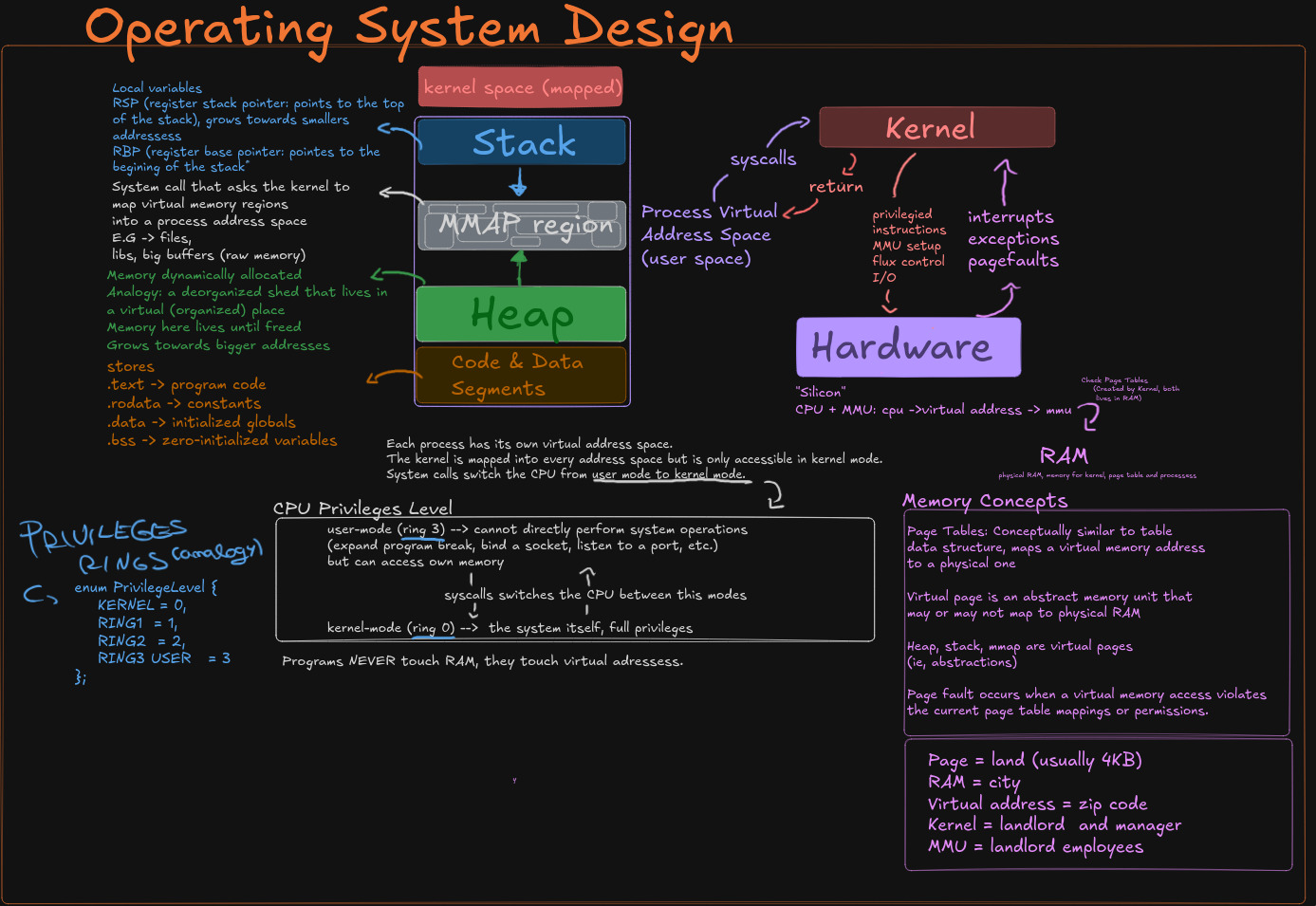
This note is an attempt to organize how I currently understand memory and CPU interactions inside a modern operating system. Not as an exhaustive specification, but as a mental model: where things live, who owns what, and how control flows between layers.
I am intentionally mixing concrete examples (mostly in C) with conceptual explanations. Memory is not only about addresses and bytes, but about responsibility: who is allowed to touch what, and under which conditions.
Stack versus Heap
When a program is running, its memory is not a single flat space. Even though everything is virtual, the address space is structured. Two of the most discussed regions are the stack and the heap.
They solve different problems and follow very different rules.
Stack
The stack lives in user space, inside the process virtual address space. It is created by the kernel when a process (or thread) starts. As abstraction, you can imagine as a literal stack of things (that grows down, see why some abstractions doesn't work well?)
The stack is:
- automatically managed (in LIFO ordering)
- bounded in size
- grows toward lower virtual addresses
- tightly coupled to function calls
Local variables usually live here.
void foo() {
	int x = 42;
	char buffer[128];
}
In this example:
xandbufferlive on the stack- their lifetime is bound to the execution of
foo - when
fooreturns, this memory is considered invalid
The CPU participates directly in stack management through registers:
RSPpoints to the top of the stackRBP(when used) marks the base of the current stack frame
The stack is fast, predictable, and fragile. Overflowing it is not a “logic error” — it is a memory violation, and the kernel will step in.
Heap
The heap also lives in user space, inside the process virtual address space, but unlike the stack, it is explicitly managed.
Memory on the heap is usually requested via allocators:
int *arr = malloc(10 * sizeof(int));
Here:
arrlives on the stack- the memory returned by
malloclives on the heap - that's why arr is a pointer!!
The heap:
- grows toward higher virtual addresses
- has no automatic lifetime
- exists until explicitly freed (or until process termination)
free(arr);
Unlike the stack, the heap introduces temporal complexity. You can free memory too early, too late, or never.
The kernel does not manage heap blocks directly. It provides virtual memory regions, and user-space allocators organize them.
MMAP
mmap is where the abstraction becomes explicit.
Instead of asking for “objects” or “arrays”, a program asks the kernel:
“Map a virtual memory region for me.”
void *ptr = mmap(NULL, 4096, PROT_READ | PROT_WRITE, MAP_PRIVATE | MAP_ANONYMOUS, -1, 0);
What lives where:
- the returned pointer lives on the stack
- the mapped memory lives in a virtual memory region
- the mapping metadata lives in the kernel
mmap regions can back:
- files
- shared memory
- large buffers
- custom allocators
Unlike the heap, mmap works in pages, not bytes.
A memory page is like a OS WORD
Definitions OS WORD --> lowest chunk of bits a Operating System fetches, decodes and executes (usually 32 or 64 bits)
Memory page --> lowest amount of RAM a kernel manages (usually 4KB)
This is where virtual memory stops pretending to be continuous and starts revealing its page-based nature.
Kernel
The kernel does not live in user space.
Each process has its own virtual address space, but the kernel is mapped into all of them, at a reserved, protected region. User code cannot access it directly.
The kernel lives in kernel space, and it owns:
- page tables
- process descriptors
- file descriptors
- hardware drivers
- scheduling state
Kernel interactions with user-space programs
User programs interact with the kernel through system calls.
write(1, "hello\n", 6);
This single line causes:
- A transition from user mode (ring 3) to kernel mode (ring 0)
- The kernel to validate arguments
- The kernel to interact with a device driver
- A return back to user mode
The important point: user programs never touch hardware or physical memory directly. They request services, and the kernel decides.
Kernel interactions with hardware
The kernel is the only software allowed to:
- configure the MMU
- handle interrupts
- manage page faults
- access I/O ports and memory-mapped devices
When a page fault occurs:
- The CPU traps into the kernel
- The kernel inspects the faulting address
- The kernel decides whether:
- to map a page
- to load data from disk
- or to kill the process
This is not an error path — it is normal execution.
Hardware
At the lowest visible level, everything converges into hardware. "The Silicon"
RAM && MMU
RAM is physical memory. Programs never see it directly.
The MMU (Memory Management Unit) sits between:
- the CPU (that generates a virtual address)
- and physical memory
Every memory access follows this path:
CPU → virtual address → MMU → physical address → RAM
Page tables live in RAM, but are owned and managed by the kernel.
A virtual address:
- may map to physical RAM
- may map to a file
- may map to nothing
When it maps to nothing, the kernel gets involved.
This is why memory is not just storage — it is policy and management.
Conclusion
Memory and CPU Architecture often are taking as two separate subjects in videos. Although its a good way to differentiate between topics, they are intricately together. To understand memory you need to understand the basics of CPU Architecture and vice-versa. After all of this reading, this note helped me organizing better my thought on memory and I hope it helps someone too.